 Add to Chrome
 Add to Firefox
 Add to Edge
Playing with Words, Improving with Rewards: Training Language Models for Creative Association
May 27, 2026
Large Language Models (LLMs) are being applied to increasingly difficult problems and use cases. To navigate their vast solution spaces effectively, LLMs need to be creative. Yet the subjective nature of creativity and the limits of human judgment make training LLMs for creativity especially challenging. As a solution, we train LLMs on Codenames, a word-association game that exercises the two central axes of creativity, divergent and convergent thinking, while yielding objectively verifiable outcomes. This verifiability lets us bypass human judgment and train with Reinforcement Learning with Verifiable Rewards (RLVR). We train Qwen3-1.7B, 4B, and 8B models and evaluate them on ten creativity and four reasoning benchmarks. We find that the precision-diversity trade-off is scale-dependent: the 8B model prioritizes creativity over precision, while the 1.7B and 4B models gain reasoning precision at the cost of creativity. Concretely, the 8B model shows modest but consistent creativity gains (8 of 10 benchmarks) with only minor reasoning degradation, whereas the smaller models achieve substantial gains on reasoning tasks. Our study presents a scalable and effective solution to train LLMs for creativity.

Diverse, not Short: A Length-Controlled Self-Learning Framework for Improving Response Diversity of Language Models
May 22, 2025
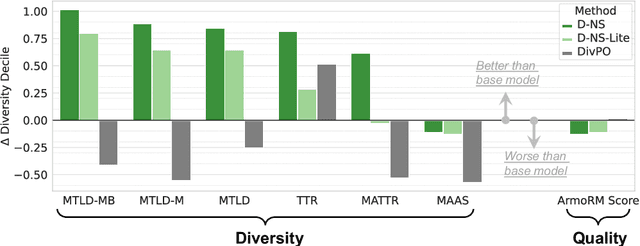
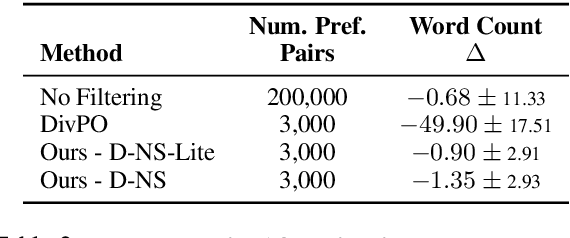
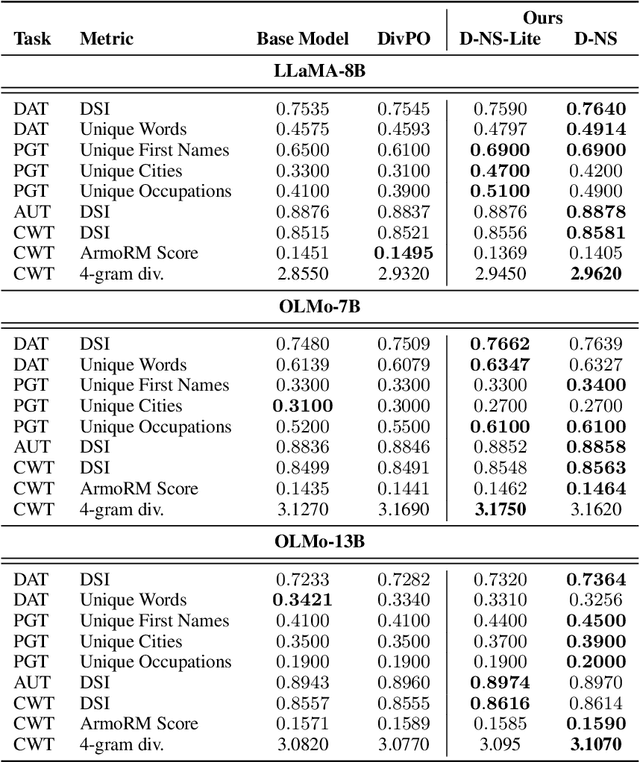
Diverse language model responses are crucial for creative generation, open-ended tasks, and self-improvement training. We show that common diversity metrics, and even reward models used for preference optimization, systematically bias models toward shorter outputs, limiting expressiveness. To address this, we introduce Diverse, not Short (Diverse-NS), a length-controlled self-learning framework that improves response diversity while maintaining length parity. By generating and filtering preference data that balances diversity, quality, and length, Diverse-NS enables effective training using only 3,000 preference pairs. Applied to LLaMA-3.1-8B and the Olmo-2 family, Diverse-NS substantially enhances lexical and semantic diversity. We show consistent improvement in diversity with minor reduction or gains in response quality on four creative generation tasks: Divergent Associations, Persona Generation, Alternate Uses, and Creative Writing. Surprisingly, experiments with the Olmo-2 model family (7B, and 13B) show that smaller models like Olmo-2-7B can serve as effective "diversity teachers" for larger models. By explicitly addressing length bias, our method efficiently pushes models toward more diverse and expressive outputs.
Creative Preference Optimization
May 20, 2025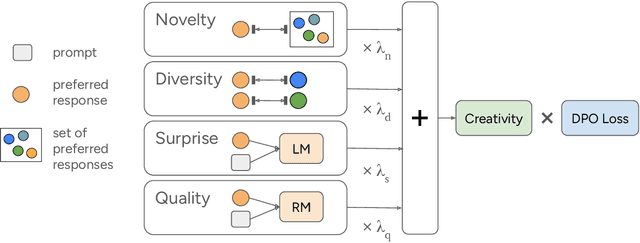
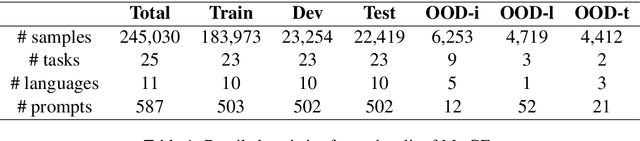
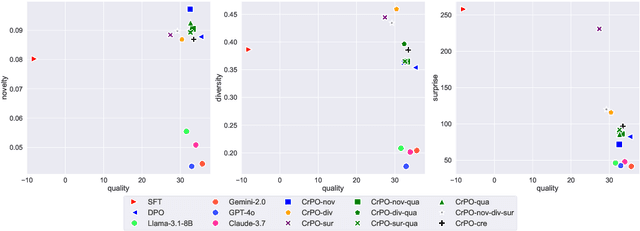
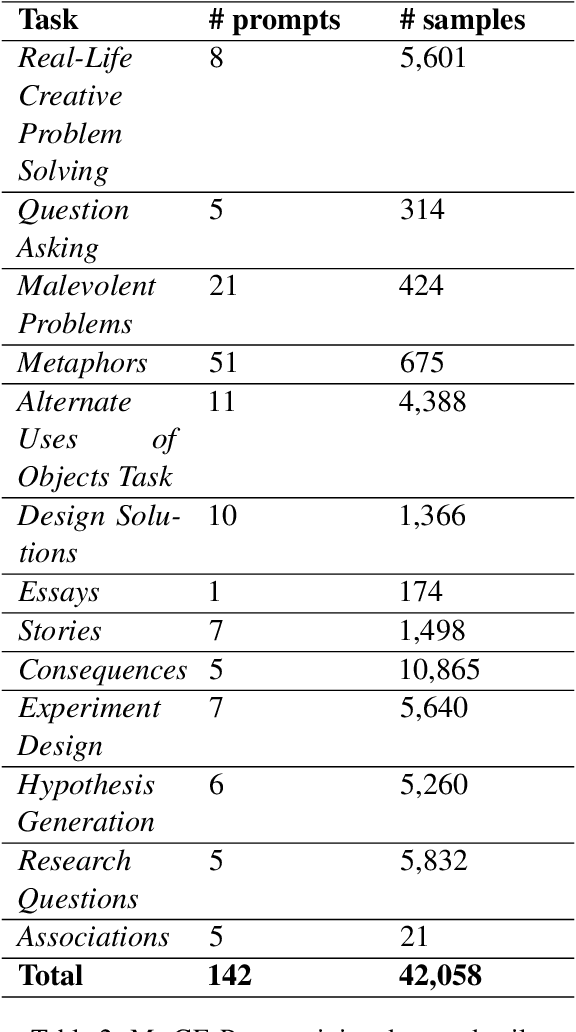
While Large Language Models (LLMs) have demonstrated impressive performance across natural language generation tasks, their ability to generate truly creative content-characterized by novelty, diversity, surprise, and quality-remains limited. Existing methods for enhancing LLM creativity often focus narrowly on diversity or specific tasks, failing to address creativity's multifaceted nature in a generalizable way. In this work, we propose Creative Preference Optimization (CrPO), a novel alignment method that injects signals from multiple creativity dimensions into the preference optimization objective in a modular fashion. We train and evaluate creativity-augmented versions of several models using CrPO and MuCE, a new large-scale human preference dataset spanning over 200,000 human-generated responses and ratings from more than 30 psychological creativity assessments. Our models outperform strong baselines, including GPT-4o, on both automated and human evaluations, producing more novel, diverse, and surprising generations while maintaining high output quality. Additional evaluations on NoveltyBench further confirm the generalizability of our approach. Together, our results demonstrate that directly optimizing for creativity within preference frameworks is a promising direction for advancing the creative capabilities of LLMs without compromising output quality.
The creative psychometric item generator: a framework for item generation and validation using large language models
Aug 30, 2024Increasingly, large language models (LLMs) are being used to automate workplace processes requiring a high degree of creativity. While much prior work has examined the creativity of LLMs, there has been little research on whether they can generate valid creativity assessments for humans despite the increasingly central role of creativity in modern economies. We develop a psychometrically inspired framework for creating test items (questions) for a classic free-response creativity test: the creative problem-solving (CPS) task. Our framework, the creative psychometric item generator (CPIG), uses a mixture of LLM-based item generators and evaluators to iteratively develop new prompts for writing CPS items, such that items from later iterations will elicit more creative responses from test takers. We find strong empirical evidence that CPIG generates valid and reliable items and that this effect is not attributable to known biases in the evaluation process. Our findings have implications for employing LLMs to automatically generate valid and reliable creativity tests for humans and AI.